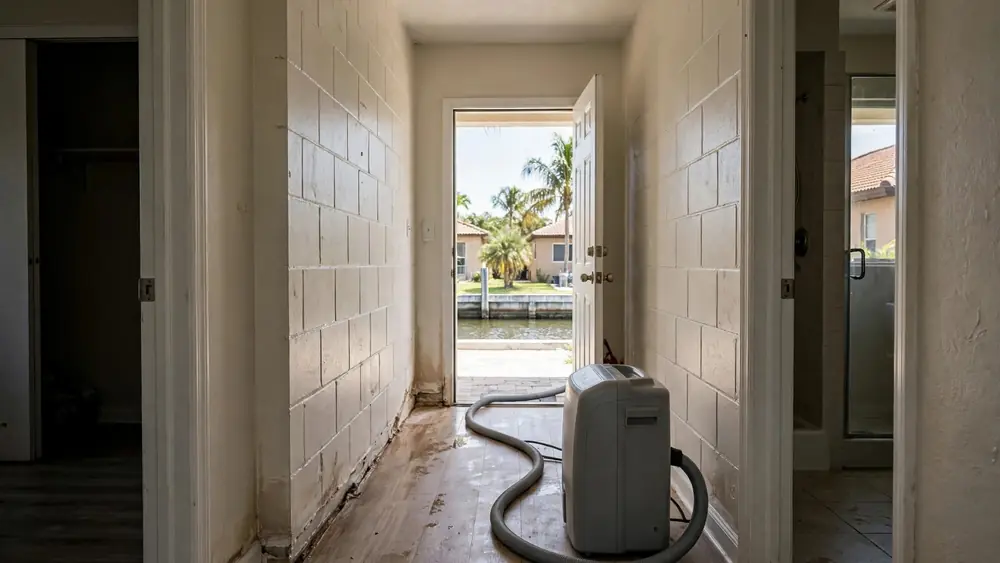
Key facts: Water Extraction and Drying
- For this kind of damage, the EPA's mold guidance sets a 24 to 48 hour drying goal [1].
- The EPA advises keeping indoor relative humidity below 60 percent, ideally 30 to 50 percent [1].
- The IICRC S500 standard is the widely used trade reference for water damage restoration procedures [2].
- Port Charlotte's climate has long, hot, humid summers with frequent afternoon thunderstorms [3].
Removal first, because a fan cannot move a puddle
The short version: every gallon a machine physically lifts out is a gallon that does not have to evaporate into the air of your home. Extraction therefore comes first, and it usually removes far more water in an hour than days of drying could. Only after the floors stop giving up water does it make sense to bring in air movers and dehumidifiers.
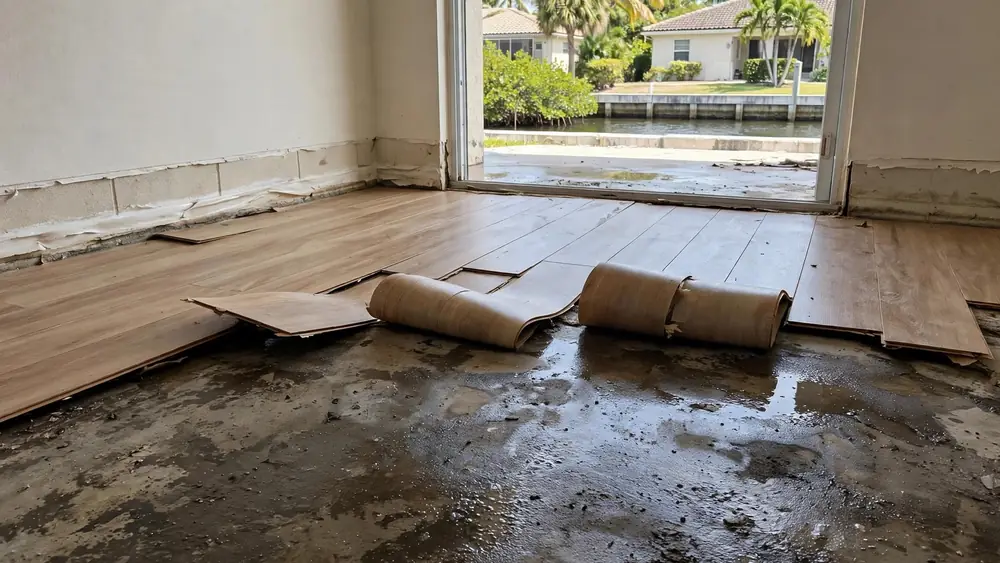
That order matters more on the concrete slabs common in Southwest Florida. Water on a slab has nowhere to drain, so it runs along the lowest line of the floor, slips under baseboards and walls, and sits beneath carpet pad, vinyl plank and loose tile. A floor that looks nearly dry on top can still hold enough water underneath to keep a room humid for a week.
Drying is the second half and the slower one. It works by warming and moving air across wet surfaces so moisture leaves the material, then pulling that moisture out of the air with a dehumidifier and sending it down a drain hose. Remove any one of those parts and the process stalls. Fans alone just spread damp air around the house.
Clues the water has gone beyond a mop and towels
Carpet that squelches underfoot
The pad below acts as a sponge and holds water long after the fibers feel merely damp.
Read moreDark lines along tile grout
Grout darkens when water is trapped below the tile, often days after the visible puddle has gone.
Read moreSwollen baseboards or door casings
Trim soaks up water from the end grain and from the wall behind it.
Read moreMusty air with the AC running
Air conditioning removes some moisture but rarely enough once a whole room has been wet.
Read morePaint blistering low on the wall
Water is coming through the drywall or the block behind it.
Read moreWater returning after you dried it
Either the source is still active or the water is working out of the material beneath.
Read more
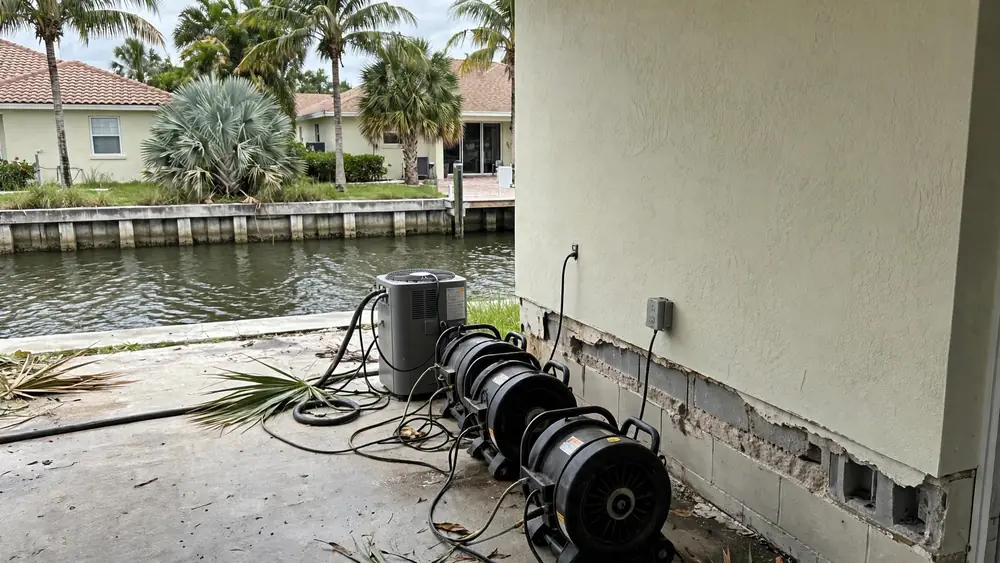
Where the standing water tends to come from around Port Charlotte
Inside the home, common sources are failed supply lines under sinks and behind toilets, washing machine hoses, water heaters, and the condensate system of the air conditioner. These usually start as clean water, which gives you the widest range of options if you act early. From above, a storm-damaged roof can dump water through a ceiling, and the wet insulation and sagging drywall complicate extraction because you have to clear hazards from overhead first.
From outside, heavy rain, surge and river flooding are a different category altogether. County records and National Weather Service summaries describe significant surge-related damage in Charlotte County in 2024, with more than 1,900 structures recorded with major damage after Helene [4]. Outside water is handled as contaminated, and it changes which materials can stay, which is why it has its own surge and flood cleanup page.
What a typical extraction and drying visit involves
- 1
Stop the source and check safety
The contractor confirms the water is off and checks for electrical hazards. If power to the wet area is doubtful, it should be sorted out before equipment gets plugged in.
- 2
Photograph and meter the starting point
Good practice is to record photos and moisture readings before moving anything. Those records show how wet each area was, which helps with insurance and with knowing when you are done.
- 3
Move contents and protect them
Furniture goes up on blocks or out of the room. Items that bleed dye or swell get separated from wet floors.
- 4
Extract standing water
Truck-mounted or portable extractors, submersible pumps and wet vacuums pull water from floors, and weighted tools can squeeze more out of carpet and pad.
- 5
Decide what comes out
Wet pad is commonly removed, and baseboards may be pulled so air can reach behind them. Drywall that is contaminated or too saturated is cut above the wet line.
- 6
Set up the drying system
Air movers push air across wet surfaces while dehumidifiers remove the moisture. The doors and windows generally stay closed so the machines are not fighting the outside air.
- 7
Read progress and adjust
Moisture in materials and temperature and humidity in the room are checked as the work goes, and equipment gets moved, added or removed based on those numbers.
- 8
Confirm dry and hand over
Drying ends when materials reach an acceptable reading compared with a dry reference area in the same house, not at a set number of days. Then rebuild can begin.
Extraction and drying equipment explained
| Equipment | What it does | Where it helps most |
|---|---|---|
| Submersible pump | Moves deep standing water out fast | Garages and rooms after flooding |
| Portable or truck-mounted extractor | Pulls water from floors and carpet | Carpet, tile and hard floors |
| Weighted extraction tool | Presses water from carpet and pad | Carpet that might be saved |
| Air mover | Blows air across wet surfaces | Walls, floors, cabinets |
| Low-grain or LGR dehumidifier | Removes moisture from humid air | Closed-up Florida rooms |
| Desiccant dehumidifier | Dries air using an absorbent material | Dense or hard-to-dry assemblies |
| Moisture meter and thermal camera | Finds and tracks hidden moisture | Walls, slab and ceilings |
Floors
Can the carpet, tile and vinyl stay?
With clean water and a quick start, carpet can sometimes be lifted and dried, though the pad commonly goes because it holds water and is hard to dry in place. With contaminated or outside water, carpet and pad are generally removed. Time matters too. Water that begins clean can degrade the longer it sits in a warm house.
Tile laid directly on a slab often survives, though water trapped below can keep grout dark for a while and loose tiles may need resetting. Vinyl plank and laminate float over the slab and trap water below them, so a section may have to come up just so the slab can dry. Laminate that swells rarely recovers. Engineered and solid wood floors are less common here but need slower, specialised drying when present.
- Pad usually comes out
- Loose plank traps water on the slab
- Tile often stays, grout may stay dark for a while
Reading the job before machines arrive
| What you can see | What it suggests | What to tell the contractor |
|---|---|---|
| Puddles on tile only | Probably caught early, check under baseboards | Time the leak started |
| Wet carpet in two rooms | Water has crossed under the wall | Which rooms and how far |
| Ceiling dripping into room | Attic is wet, overhead hazard | Whether the ceiling sags |
| Mud on the floor | Outside water, treat as contaminated | How high the waterline reached |
| Damp smell, no puddle | Hidden long-term leak | When the smell began |
Steps that are safe to take while you wait
Skip anything that puts you near live electricity or in contaminated water.
- Shut the main water valveFind the shutoff before you need it. It often sits near the meter or where the line enters the home.
- Turn off the affected circuitOnly if the panel is dry, you are standing on a dry surface and you are confident about it.
- Lift what you canMove rugs, cords, books and boxes off wet floors. Put foil or plastic under furniture legs to limit staining.
- Take wide and close photosInclude waterlines, the source, and the serial numbers of damaged appliances if handy.
- Blot and mop clean waterRemoving even a little helps, but stop if the floor is slippery or the water may be dirty.
- Keep the air conditioning decision openAsk the contractor. Running AC can help with humidity, but not if the air handler or its ducts got wet.
When a shop vacuum really is enough
A small clean-water spill on tile or sealed vinyl, caught within minutes and confined to a corner of one room, can often be handled with a wet vacuum, towels and a household dehumidifier. Check under the edge of the baseboard and in the adjacent room to be sure it did not travel. If it stays limited and nothing reads wet the next day, you may be finished.
It stops being enough when the water has reached carpet, when it has crossed under a wall, when it came from outside, when it ran for more than a few hours, or when you cannot find where it went. A shop vacuum also holds little and removes only what sits on the surface. It cannot deal with the water that has already moved into drywall or under flooring.
Why Port Charlotte air makes drying harder
Drying depends on the difference between the moisture in the material and the moisture in the surrounding air. In a dry climate, opening the windows might help. In Port Charlotte, with summers described as long, hot and humid [3], outdoor air often carries more moisture than the air you are trying to create indoors. That is why opening up the house during a wet July afternoon can set the job back.
The goal is usually a closed, controlled room with dehumidifiers doing the heavy lifting. EPA guidance on keeping indoor humidity below 60 percent, and ideally between 30 and 50 percent, gives you a useful reference [1]. A small hygrometer lets you watch that number yourself. Winter here is milder and much drier [3], so the same job may behave differently in January than in August.
Power is another local factor. After a hurricane, outages can stop equipment for days. Generators must run outdoors and well away from windows [5], and they may not support a full drying setup, so ask the contractor what they would do during an outage and what they would prioritise.
Slab and block walls set the pace of drying
Southwest Florida's concrete slabs and block walls are durable but slow to give up water. Concrete is porous and holds moisture deep in its mass, and it releases that moisture gradually. Flooring installed too soon over a damp slab can cup, lift or grow mold from below. That is why many contractors check slab moisture before anyone reinstalls a floor, even if the surface looks perfectly dry.
Block walls usually have furring strips and drywall fastened to the interior, leaving a shallow cavity. Water that enters that cavity has very little room to escape. A contractor may drill small holes behind the baseboard or remove the bottom section of drywall to get air inside. Ask which option they recommend and why, since each has trade-offs for the rebuild.
Newer homes and additions may have wood-frame interior walls next to block exterior ones, and those two wall types dry at different rates. A single reading from one wall does not tell you about the whole house.
What drying records should show when the job ends
A useful drying log is simple: the date, the location of each reading, the material being read, and the room's temperature and humidity. Over the days, the numbers should fall towards the reading from a dry reference area of the same material. If they stall, somebody should be asking why. Common reasons include a remaining leak, hidden wet insulation, or too little airflow behind cabinets.
Ask for a copy of those records. They help you decide when to rebuild, and your insurer may want them too. They also give the next contractor something to work from if you bring in a different company for repairs. A written log is much stronger evidence than a statement that everything looks fine.
Cabinets, closets and the places air misses
Kitchen and bathroom cabinets create a pocket that air movers cannot easily reach. Toe-kick panels can often come off to let air under the cabinets, and sometimes small holes or specialised drying mats are used. If the cabinet boxes are particleboard and they have swollen, removal may be the honest answer, since swollen particleboard does not return to its old shape.
Closets deserve attention because they are small, stuffed with fabric and often forgotten. Empty them. Wet shoes and bags can keep a closet damp long after the rest of the bedroom reads dry. Hollow-core doors and wood jambs may swell too, and they are worth rechecking after everything has settled.
Telling Port Charlotte's extraction work apart from surge cleanup
This page deals mainly with removing water and drying the house, whichever way it arrived. When harbor, canal or river water has reached the home, those steps happen alongside contamination control: silt removal, cleaning and disinfecting, and more aggressive removal of porous materials. In that case read the separate flood page first and treat these steps as the later part of the work.
If you are not sure, tell the contractor where you think the water came from and whether anyone else on your street was affected. Neighbours' experiences, a visible waterline and mud are all useful clues.
How common materials usually fare after extraction
| Material | Typical result | What to check |
|---|---|---|
| Carpet pad | Usually replaced | Odor and staining on the slab |
| Carpet | May be saved with clean water | Delamination, shrinkage, smell |
| Drywall | May dry if briefly wet | Softness, swelling, paper damage |
| Wood baseboard | Sometimes saved, often replaced | Swelling and split joints |
| Particleboard cabinets | Often fail if swollen | Bottom panels and toe-kicks |
| Porcelain or ceramic tile | Often stays | Hollow sound, loose tiles, grout |
| Block wall | Stays, dries slowly | Readings, efflorescence, peeling paint |
Documenting extraction for your insurer
Insurance terms vary widely, so read your own policy and speak with your insurer about what is covered. As a practical matter, take photographs before cleanup where it is safe, keep damaged samples where sensible, and write down the time you discovered the water and what you did about it. Florida law generally bars a new or reopened claim unless notice reaches the insurer within one year of the date of loss [6], but most policies also expect prompt notice and reasonable steps to limit damage.
Ask for itemised records of what equipment was used and for how many days. Do not sign anything you do not understand. If you get stuck, the insurance deadlines guide has more detail, and the Florida Office of Insurance Regulation publishes consumer information [7].
Questions to put to a Port Charlotte contractor about drying
Ask what standard they work to, as many restorers refer to the IICRC S500 [2]. Ask how they will know the house is dry, and whether you can see the readings. Ask how they plan to handle the slab, how they will control humidity with the house closed up, and what happens if the power fails.
Ask who holds the licence for any building work that follows, then check the name on the state's licensing portal [8]. If mold becomes part of the discussion, ask who will assess it and who will remediate it, as Florida law restricts one firm doing both on the same structure within twelve months, with limited exceptions [9].
Reducing the odds of doing this again
- Know your shutoffMark the main valve so anyone in the house can find it.
- Check supply linesLook at braided hoses under sinks and behind toilets and replace worn ones.
- Treat your condensate drainAsk your HVAC technician how to keep the line clear and whether a float switch makes sense.
- Leave when you leaveTurning off the water when you go north for the summer is worth considering for seasonal homes.
- Keep humidity in checkAim for under 60 percent indoors and watch it with a hygrometer.
Seasonal homes and slow discovery
Many homes in this area sit empty for part of the year, and Port Charlotte's median age of 53.8 and a large group of residents over 65 reflect a community with plenty of retirees [3]. A leak that starts when nobody is home can run for weeks in a warm closed house. By the time someone opens the door, the water may have reached several rooms and mold may already be growing.
If that describes your situation, say so up front. The contractor will want to check for mold before setting up air movers, because blowing air across moldy materials can spread spores. EPA guidance points to professional help when moldy areas are larger than about 10 square feet or there has been significant water damage [1]. A house-watcher or a shutoff valve with a sensor can make the next absence less stressful.
FAQ
Port Charlotte water extraction and drying questions
How long will drying equipment run in my house?
Many jobs run several days, but the readings decide. Wet slabs, soaked block and summer humidity can stretch that. Ask to see moisture numbers each visit, and be cautious of anyone who picks an end date before metering the materials.
Can I turn off the noisy machines at night?
It is better not to without asking. Stopping equipment lets humidity climb back up and can lengthen the job. If noise is a real problem, ask the contractor whether placement or settings can change, or whether a bedroom can be left out for the night.
Should I keep my air conditioning on during drying?
That depends. It may help with humidity if the system itself is clean and dry, but if water reached the air handler or duct work you could be spreading contaminated air. Ask the contractor and an HVAC technician before running it.
Why do they want the windows shut in Florida?
Outdoor air in Port Charlotte is often very humid, and dehumidifiers work best in a closed space. Leaving windows open brings in moisture the machines must remove again. Dry winter days may be an exception, but follow what the readings indicate.
Do I have to tear up my tile?
Not always. Tile bonded to a slab often survives clean water, and grout may slowly return to its normal color. Tiles that sound hollow or lift may need attention, and contaminated water raises other questions about what lies underneath.
How do I know the slab is dry enough for new flooring?
Ask for a moisture test of the slab rather than relying on looks. Flooring makers often specify acceptable moisture limits for their products, so check those instructions. Installing too early can trap water and cause cupping, odors or mold.
Is it fine to dry a wet room with fans I already own?
Fans alone move air but do not remove water from it. For small clean spills they can help alongside a dehumidifier. For larger events they may spread damp air to dry rooms, so metered drying is the safer choice.
What should I do with soaked furniture?
Move it off wet floors, photograph it and keep it for your insurer to see if possible. Upholstered pieces that touched floodwater are often not worth keeping, whereas solid wood may recover if dried slowly and away from direct sun.
Sources and citations
- [1]U.S. EPA: A brief guide to mold, moisture and your home
- [2]IICRC: ANSI/IICRC S500 water damage restoration standard
- [3]Wikipedia: Port Charlotte, Florida
- [4]National Weather Service Tampa Bay: Hurricane Helene impact narratives
- [5]Ready.gov: Floods
- [6]Florida Statutes 627.70132: Notice of property insurance claim
- [7]Florida Office of Insurance Regulation
- [8]Florida DBPR: Licensing portal
- [9]Florida Statutes 468.8419: Mold assessor and remediator prohibitions