
Key facts: Wet drywall: keep or cut
The simple rule, and why it has exceptions
Think about two things: what the water carried and how long it stayed. Drywall is gypsum wrapped in paper, and both soak up water. When flood or sewage water reaches it, the board holds contamination you cannot wash out, so it is normally cut. When a clean supply line wets a wall for a few hours and it gets dried right away, the board may recover. The longer the delay or the dirtier the water, the stronger the case for removing it.
The wall itself also matters. On a Southwest Florida block home, the drywall is often fixed to furring strips against the block. That leaves a shallow gap that traps water and hides what is happening. An intact-looking wall can have wet furring behind it, so reading the wall from the front is only part of the job.
Keep or cut: a decision table
| Situation | Usual call | Why |
|---|---|---|
| Floodwater touched the wall | Cut above the line | Contaminated, wet cavity behind |
| Clean leak, caught quickly, board firm | Try drying | Gypsum may recover |
| Clean leak, several days old | Probably cut | Mold likely behind the paper |
| Board crumbling or sagging | Cut | Strength is lost |
| Insulation in the wall soaked | Cut | Wet insulation holds water |
| Stain on ceiling, dry and firm | Seal and paint | Cosmetic once the leak is fixed |
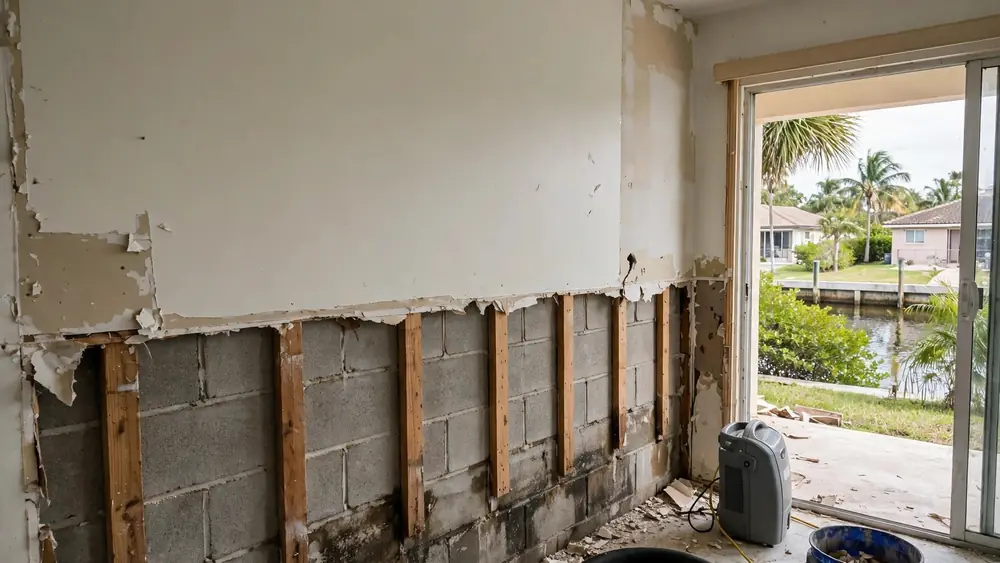
How high to cut
A flood cut is a straight cut above the wet line, and it is usually higher than the stain. Water wicks up the paper and gypsum, so readings above the visible mark matter. Some contractors cut at a set height to make repairs easier with standard sheets, whereas others follow the readings. Both can be reasonable. Ask to see readings, and ask why the height was chosen.
Cutting too low leaves wet material behind, and cutting too high adds unneeded work. For a repair, seams at a consistent height tend to look better than patchy ones, so a slightly higher, straight line may make sense. Trim, electrical boxes and cabinets also influence where the line goes, so be sure to discuss those ahead of time.
Checking a wet wall yourself, safely
- 1
Make sure the power is off in that area
Do not put tools or meters near wet outlets.
- 2
Photograph it
Take the whole wall and the line of the stain with a tape measure in view.
- 3
Press gently
Firm board is one thing, and soft board or paper that peels is another.
- 4
Tap the base
Hollow or crumbly sounds suggest failure.
- 5
Check the room next door
Water often crosses under walls.
- 6
Take off a baseboard if you can
Look behind it for staining or wet board, and keep the piece for reinstalling or for your records.
- 7
Decide who should cut
Leave it to a contractor if there is contamination, older materials or wiring in the way.
Why older drywall deserves extra caution
Disturbing building materials in older homes can raise other questions, including old paint and other hazardous materials. If your house has seen no renovation in decades, ask a contractor about testing before anyone starts cutting and sanding. This is a general caution, not a statement about any home in particular.
Wet wiring in the cavity also needs care. If the cut exposes wet cables or boxes, ask an electrician to check them. Salt water deserves extra attention, as it can damage metal connections slowly.
Behind the board
What happens to the wall cavity afterward
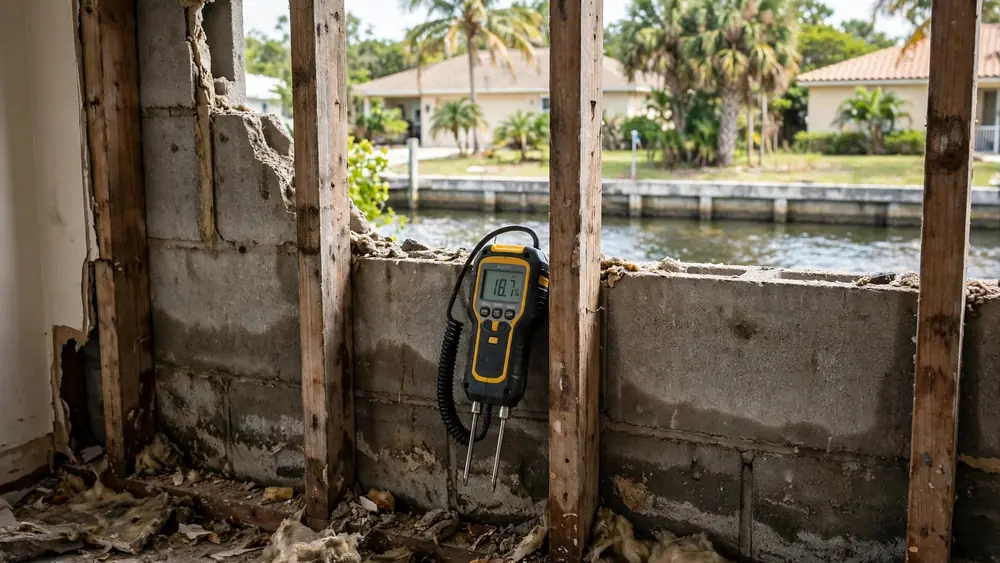
Once the board is out, the cavity needs cleaning and drying. Silt comes out first. Furring, block and any framing are cleaned, rinsed where salt is a concern, and then dried. Do not close the wall on the strength of a good feeling. Moisture readings on framing and block should reach an acceptable level compared with an unaffected area of the same material.
It is at this point that you will find out whether your drying plan worked. If readings stall, check whether water is still arriving from outside or the slab.
- Remove silt from the bottom plate
- Rinse where salt reached
- Read the framing before closing
Mold on drywall paper
Drywall paper feeds mold readily. The EPA says it may be necessary to discard porous materials such as ceiling tiles and carpet if they become moldy, since mold can fill the empty spaces [1]. For moldy drywall, removal is frequently the realistic answer. Painting over it doesn't help, as paint on moldy surfaces is likely to peel. Follow the EPA's guidance on protective gear, and for larger areas or significant water damage, consider professional help [2].
Before anyone starts cutting, ask
- What readings support this?Good answers refer to measurements, not impressions.
- What will you keep for my insurer?Samples and photos can be useful.
- Is a permit required for the repair?Check with the county or city before rebuilding.
- How will the cavity be cleaned?Particularly important with floodwater.
- Who checks the wiring?Wet boxes and cables may need an electrician.
FAQ
Wet drywall questions
How long can drywall stay wet before it is ruined?
There is no exact number, but the EPA's drying advice of 24 to 48 hours gives you a useful target. Floodwater shortens the question, as contaminated board usually goes anyway. Soft or sagging board has already lost its strength.
Can I just paint over a water stain?
Only after the leak is fixed and the board reads dry. Use a stain-blocking primer before paint. If the board is soft or moldy, paint will not fix it, and it may peel while trapping moisture behind it.
Why cut drywall when the stain is only a few inches high?
Wicking pulls water above the visible line, and the cavity behind may be wet. A flood cut lets air reach the block and framing. Ask for meter readings along the wall to back up how high they plan to cut.
Do I need to replace insulation too?
Often, yes, when it was soaked. Wet insulation holds water against the structure and dries slowly. Many block walls have only thin insulation or none, so what you find depends on your house. Your contractor can show you once the wall opens.
Can I cut the drywall myself?
You can for some clean-water situations, once power is off and you are wearing protection. Leave it to a contractor if water was contaminated, if the home is older, or if wiring is involved. Photograph everything first for your records.