Key facts: Storm Surge and Flood Cleanup
- Peak water levels along coastal Charlotte County were estimated at 2 to 5 feet above MHHW in Helene and 4 to 8 feet in Milton [1] [2].
- Helene left more than 1,900 structures with major damage in Charlotte County, according to the National Weather Service [1].
- During Ian the Peace and Myakka rivers crested at record levels, while most surge sensors placed in Port Charlotte remained dry [3].
- Charlotte County requires buildings to meet current code when repairs exceed 50 percent of building value [4].
The difference between a leak and a flood in your house
Outside water should be treated as contaminated. The EPA notes floodwater may contain microorganisms and chemicals, and that items wet for more than two days usually grow mold [5]. That single fact changes the cleanup. A clean-water leak allows you to dry a lot of what got wet. A flood generally means porous things that touched the water must come out, the remaining surfaces must be cleaned, and only then does drying begin.
In Port Charlotte and its neighbours there is also salt, which many inland flood guides ignore. Water pushed up Charlotte Harbor and into canals can leave a salty film that attracts moisture and attacks metal. And there is mud. A thin layer of fine silt on the floor can hide a lot of what is under it, and it clings to the inside of wall cavities too.
Water sources that reach Port Charlotte homes
- Surge pushed up the harborHelene and Milton both pushed water into low-lying parts of the county, including downtown Punta Gorda [1] [2].
- Canals and waterfront edgesCanal-front lots may flood early when water levels rise, and seawalls can be overtopped.
- Rivers after heavy inland rainIan brought record crests on the Peace and Myakka rivers, days of water that came from rain rather than the Gulf [3].
- Rain and overwhelmed drainageTorrential rainfall can overwhelm ditches and swales regardless of whether you are near the shore. Milton's rain in the county generally totalled 3 to 6 inches, with an isolated 7.41 inches near Cecil Webb [2].
Signs that outside water got inside
A line on walls or cabinets
A waterline tells everyone how high to look, and photographs of it help later.
Read moreSilt across the floor
A film of mud usually means the water came from outside, so it deserves contamination precautions.
Read moreA salty crust as things dry
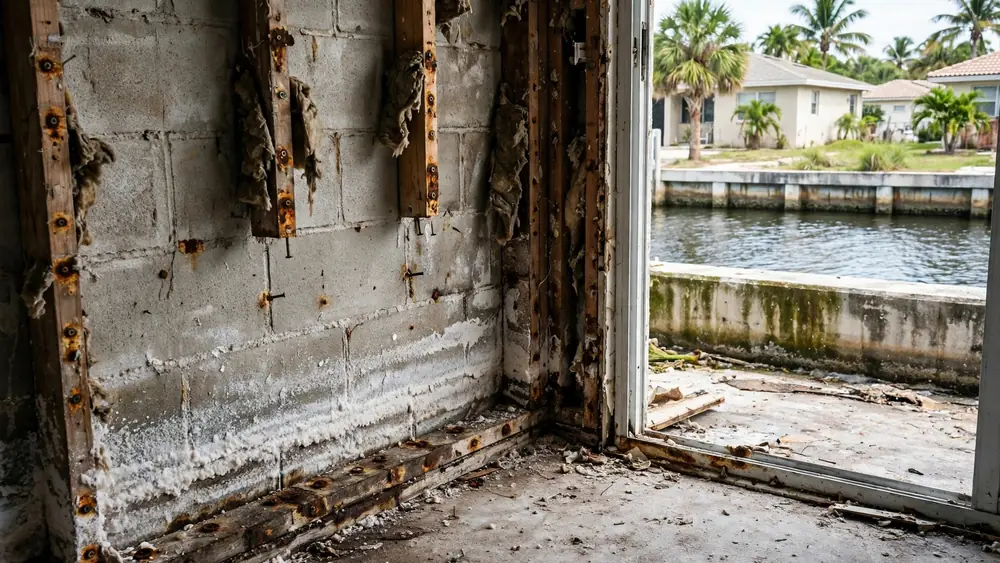
White residue on walls and metal can point to salt water or minerals coming out of masonry.
Read moreDrywall going soft from the bottom
Wet gypsum loses strength; the paper may peel and smell.
Read moreDead outlets or a tripping panel
Salt and water in electrical parts need a licensed electrician.
Read moreA garage full of floating contents
Water often enters here first, and stored chemicals may have spilled into it.
Read more
What the recent storms showed about Charlotte County
The county's storm record is a good guide to how varied flooding here can be. Charley in 2004 was an intense, compact hurricane whose eyewall struck Punta Gorda and Port Charlotte with devastating results [6]. Most of its damage was wind, but it opened thousands of homes to rain. Ian in 2022 made a landfall near Punta Gorda at an estimated 125 knots, yet the National Hurricane Center reports that most sensors placed in Port Charlotte and Englewood stayed dry because of offshore winds [3]. A USGS sensor at Pirate Harbor, south of Punta Gorda, measured only 4.47 feet above MHHW, far less than farther south [3].
In 2024 the picture flipped. Helene passed well offshore and still brought estimated peak water of 2 to 5 feet above MHHW along the Charlotte coast, with 8 structures destroyed and more than 1,900 with major damage [1]. WGCU reported that parts of downtown Punta Gorda and historic areas along the harbor flooded in both Helene and Milton [7]. Milton followed, with a measured 4.69 feet above MHHW at North Port Charlotte and estimated peaks of 4 to 8 feet along the coast [2].
Those comparisons explain a common confusion. Someone who stayed dry in Ian may assume their house is safe from water, only to have it flood in a much weaker storm that happened to approach from a different direction. Charlotte County also points out that surge does not correlate with a storm's category [8].
How flood cleanup usually proceeds in a Port Charlotte home
- 1
Confirm it is safe to enter
Authorities must have cleared the area. Have electrical and gas concerns checked, and watch for structural damage and animals that came in with the water [9].
- 2
Document everything first
Take photos of waterlines, all rooms and all damaged contents, along with any exterior damage, before anything moves.
- 3
Pump out remaining water
Water that is still standing gets pumped or extracted, with silt shovelled and squeegeed out while it is still wet.
- 4
Clear the contaminated contents
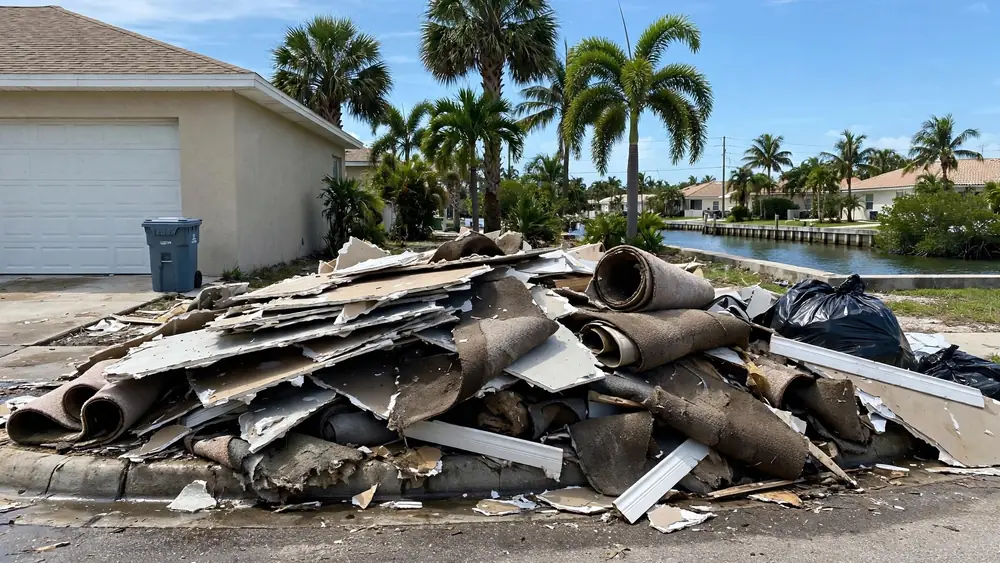
Soaked mattresses, upholstery, carpet and pad generally leave the house after they are documented.
- 5
Open the walls
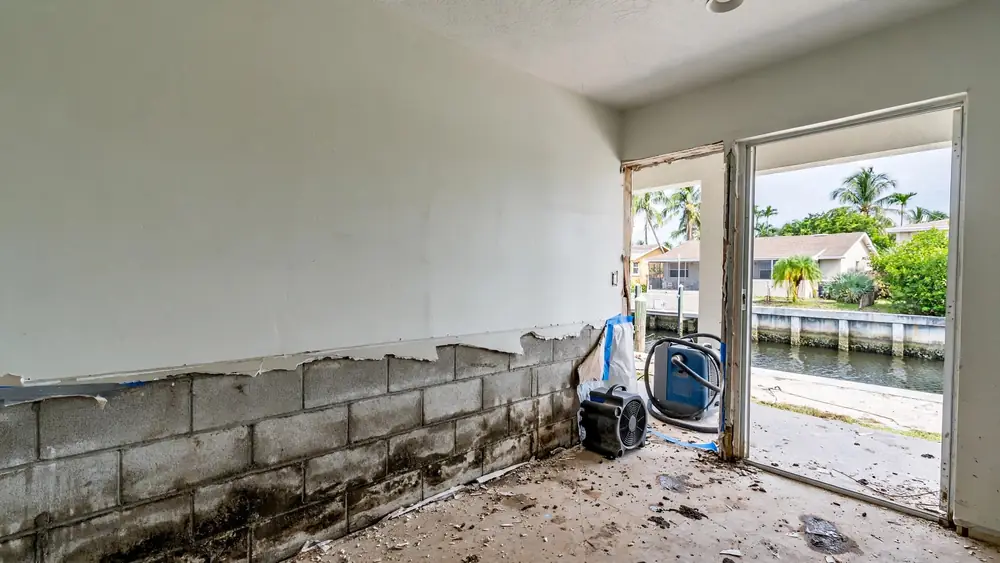
Wet drywall and insulation are usually cut out to a line above the water and wicking height, which allows the wall cavities to be cleaned and dried.
- 6
Clean and rinse surfaces
Slab, block, framing and furring are cleaned to remove silt and, where relevant, salt. Contractors differ in their products, so ask what they use and why.
- 7
Dry the structure
Air movers and dehumidifiers run until readings confirm materials are dry, a process often slowed by the Florida humidity.
- 8
Plan repairs with the permit office
Rebuilding work is coordinated with the county or city building department, including any review under the 50 percent rule.
What flood water means for common materials
| Material | Usual decision | Reason |
|---|---|---|
| Carpet and pad | Remove | Traps silt and contaminants |
| Drywall below the line | Cut out | Porous and holds contamination |
| Fiberglass insulation in walls | Remove | Holds water and silt |
| Upholstered furniture and mattresses | Usually discard | Cannot be cleaned through |
| Solid wood furniture | Often clean and dry slowly | Non-porous finishes can recover |
| Concrete block and slab | Clean and dry | Durable, slow to dry |
| Appliances and HVAC parts | Have checked | Salt and water can damage controls |
Harbor water
Why salt changes the job
Salt keeps working after the water leaves. It draws moisture from humid air, so a surface that looks dry can feel damp again on a sticky afternoon. It also corrodes metal fasteners, electrical contacts, appliance controls and the coils in air-conditioning equipment. That damage may not show up for weeks or months.
A thorough clean often includes rinsing surfaces that took salt water, particularly wall cavities and block, then drying them. Ask your contractor how they would deal with salt residue, and ask an electrician and an HVAC technician to look at anything that was submerged. Our saltwater guide explains the differences in plain language.
- Residue can pull moisture from humid air
- Metal parts may corrode for weeks
- Rinse, then dry, then recheck
The county's 50 percent rule, in plain words
Flood-zone repairs in Charlotte County come with a rule that catches many owners off guard. According to the county, its Floodplain Management Ordinance requires that when repairs or improvements exceed 50 percent of a building's value, the building must be brought up to current Florida Building Code standards, including elevation requirements [4]. For an older slab home in a flood zone, elevation may be a very significant requirement.
So before major demolition or rebuilding, speak with the Community Development department, and keep every invoice and permit record in one folder.
This is general information rather than legal or permit advice, and rules are updated from time to time. Inside Punta Gorda, ask the city's own building department rather than the county.
Knowing your zones before the next storm
Charlotte County separates two ideas that are easy to mix up. Evacuation zones are lettered A through E and relate to storm surge, determined using National Hurricane Center data, elevation and evacuation routes [8]. FEMA flood zones are about mapped flood risk and insurance requirements [8]. You can be in an outer evacuation zone and still flood from rain, and the county warns that not being in a high-risk area does not mean you will not flood.
Use the county's Know Your Zone lookup with your address [10]. Note your zone somewhere non-digital before storm season, and if you own a seasonal home, make sure whoever keeps an eye on it knows the zone too.
Silt, drains and what lurks under the mud
Silt is not just dirty. It can hold contaminants and it keeps surfaces wet underneath. It usually comes off best while still damp, so leaving it to bake on can make the job harder. Check floor drains, shower drains and garage thresholds, as mud settles in low points and can later smell or block flow.
Outside, mud in air-conditioning condensers and pool equipment should be left to the relevant technician. Septic systems and wells deserve attention too. If your property uses either, or if sewage may have backed up, ask the county health department or your utility for guidance before you resume normal use. Deep Creek and other neighbourhoods may have different utility arrangements, so it is worth confirming who serves your home.
Mold after a flood is a matter of when, not if
The EPA says items wet for more than two days usually grow mold [5], and warm, humid Port Charlotte conditions do not help. Moving contaminated materials out early does more than any spray. Painting over mold does not resolve it, and the paint will often peel. Follow EPA guidance on cleanup and protection, and consider professional help for larger areas or after significant water damage [11].
Florida treats mold work as its own licensed field. State law restricts assessors and remediators from doing both jobs on a single structure within twelve months, with limited exceptions [12]. Ask who holds what credential, then look it up on the state portal [13].
Port Charlotte flood records in brief
| Storm | What agencies recorded | What it means for homeowners |
|---|---|---|
| Charley, 2004 | Eyewall struck Punta Gorda and Port Charlotte | Mostly wind; opened roofs to rain |
| Ian, 2022 | Sensors in Port Charlotte mostly dry; rivers crested at records | Wind and river water, not local surge |
| Helene, 2024 | Coastal Charlotte peaks of 2 to 5 ft; over 1,900 structures with major damage | Surge from a distant storm |
| Milton, 2024 | 4.69 ft at North Port Charlotte; coast estimated 4 to 8 ft | Second surge in two weeks |
Two floods in two weeks, and why it matters for your paperwork
Helene in late September and Milton in early October 2024 left some Charlotte County homes flooded twice in two weeks. If that describes you, keep the two losses as separate as you possibly can: dated photographs, dated contractor records, and separate notices to your insurer if your insurer says that is needed. Flood policies and homeowner policies also treat wind and water differently, which is one reason to document both a roof opening and any outside water.
Florida's notice timelines start from the date of loss [14]. A separate storm may mean a separate date. Ask your insurer directly, and use the insurance deadlines guide for background.
What to record for flood claims and permits
- Waterline photosUse a tape measure in the shot to show height at several walls.
- Contents listNote what was damaged, its approximate age, and take a photo before it leaves the home.
- SamplesKeep a small labelled piece of carpet and wall material if your insurer wants it.
- Contractor recordsKeep moisture logs, equipment records and copies of everything you sign.
- Permit fileHold onto permits, inspections and repair invoices, since the 50 percent review can look at them.
Questions to ask before anyone starts tearing out
Ask how they plan to deal with salt and silt, and whether they will rinse wall cavities. Ask how high they plan to cut and why. Ask what they will keep for your adjuster. Ask whether their work needs a permit and who pulls it. Ask how they will verify that materials are dry before closing any wall.
Ask to see licence details if building or mold work is included, and check them through the state portal [13]. Be wary of pressure to sign paperwork on the driveway the day after a storm. You can take a moment to read it, and it is reasonable to ask your insurer about any document you are unsure of.
Getting ready before the next surge forecast
- Know your zoneLook it up on the county's map and write it down [10].
- Lift what mattersStore documents and valuables high, and use waterproof containers.
- Shoot a videoWalk through each room before a storm threatens to record the condition of contents.
- Clear the garage floorChemicals and fertilizers belong on high shelves.
- Read your flood coverAsk your agent how your policy treats flood water versus wind before you need it.
Garages, the first room to flood
Garage floors usually sit a little lower than the living space, so outside water tends to reach them first. They also hold the worst mix of things to get wet: fertilizer, pool chemicals, paint, gasoline and old batteries. Assume any of those containers may have leaked, and keep your hands and boots protected while you sort them out. Do not put soaked chemicals in with ordinary debris. Ask the county how it wants them handled.
The wall between the garage and the house deserves a close look, since water often crosses at the door threshold and wets the drywall behind it. Check the water heater and any air handler if they live out there, and photograph the garage door's lower sections, springs and motor. Salt water works on all of that hardware, and a door that lifts today may stick by the end of the month.
Vehicles are a separate claim in most cases, usually on the auto policy rather than the home one. Do not try starting a car that sat in floodwater until someone has looked at it.
Keeping documents and photographs you want to save
Paper and family photographs that got wet can sometimes be recovered if handled soon. Rinse off silt gently with clean water if the items can take it, separate pages or prints, and air dry them away from direct sun. Items you cannot deal with right away may keep for later in a freezer, if you have power. Ask a conservator about anything irreplaceable, and do not force apart pieces that have stuck together.
Gloves off, hands washed
Wash your hands before eating during any cleanup.
FAQ
Surge and flood cleanup questions from Port Charlotte
Can I stay in my house during flood cleanup?
It depends on contamination, electrical safety and how much of the home is affected. Many families stay elsewhere during demolition. People with lung conditions or weak immune systems should stay out. Ask the contractor, and follow any official notices about your street.
How high should wet drywall be cut after a flood?
Above the waterline and above any wicking, which often means more than the visible stain. The right height depends on the water level and how long the wall stayed wet. Ask for meter readings to back up the height they suggest.
Is a flood from the canal treated like a pipe leak?
No. Canal and harbor water is treated as contaminated and may contain salt. Porous materials that touched it usually go, and surfaces need cleaning before drying. A clean supply-line leak leaves far more options for keeping materials.
Why did my neighbour flood in Helene when we stayed dry in Ian?
Storm track and wind direction matter as well as strength. In Ian, offshore winds kept many Port Charlotte sensors dry, whereas Helene and Milton pushed water into the county. Your own elevation and distance from water also play a part.
Do I need a permit to replace flooded drywall?
Sometimes, and the rules can change after a storm. Ask Charlotte County Community Development, or the Punta Gorda building department if you live in the city. Flood-zone homes can also face the 50 percent review, so check before major repairs.
Will my AC unit survive saltwater flooding?
Have an HVAC technician decide. Salt can corrode coils and electrical parts, so a system that starts today might fail later. Do not power up a submerged unit until it is checked, and photograph it for your insurer first.
Is it worth keeping furniture that sat in floodwater?
Upholstered pieces and mattresses usually are not, since they absorb contaminated water deep inside. Solid wood can sometimes be cleaned and dried slowly. Photograph everything first, and check whether your insurer wants to see items before they leave.
How do I find out my evacuation zone?
Enter your address in Charlotte County's Know Your Zone map on its website. The county says street signs in your area carry color bands matching the zones. Keep the letter written down somewhere you can reach during a power cut.
Sources and citations
- [1]National Weather Service Tampa Bay: Hurricane Helene impact narratives
- [2]National Weather Service Tampa Bay: Hurricane Milton impact narratives
- [3]National Hurricane Center: Tropical Cyclone Report, Hurricane Ian
- [4]Charlotte County: 50 percent FEMA rule
- [5]U.S. EPA: Flood cleanup and indoor air quality
- [6]National Hurricane Center: Tropical Cyclone Report, Hurricane Charley
- [7]WGCU: Punta Gorda prepares for hurricane season while recovering from storms
- [8]Charlotte County: How to know if you are at risk of flooding
- [9]Ready.gov: Floods
- [10]Charlotte County: Know your zone
- [11]U.S. EPA: A brief guide to mold, moisture and your home
- [12]Florida Statutes 468.8419: Mold assessor and remediator prohibitions
- [13]Florida DBPR: Licensing portal
- [14]Florida Statutes 627.70132: Notice of property insurance claim