
Key facts: First steps after a hurricane flood
- Ready.gov says to return home only when authorities say it is safe [1].
- Six inches of moving water can knock a person down, according to Ready.gov [1].
- The EPA says items wet for more than two days usually grow mold [2].
- Florida law generally requires notice of a new or reopened property claim within 1 year of the date of loss [3].
The order that keeps people safe and claims clean
Safety comes first, records come second and cleanup comes third. That order sounds obvious until you are standing in the driveway wanting to rescue everything at once. Ready.gov's advice is to return only when authorities say it is safe, to avoid wading in floodwater, and to stay clear of wet electrical equipment [1]. In Charlotte County, that means following the county's notices for your evacuation zone, which you can look up by address [4].
Even after the water drops, roads may be blocked and streets may still be flooded in low spots. Do not drive through water. Being a day late is far less of a problem than being swept off a road.
What you see on arrival and what to do about it
| What you find | Likely issue | What to do |
|---|---|---|
| Water above outlets | Live electrical risk | Stay out; have the power checked |
| Smell of gas | Damaged line or appliance | Leave and call the gas supplier from outside |
| Sagging ceilings or cracked walls | Structural damage | Do not enter that area |
| Mud across floors | Outside water, contamination | Wear protection; photograph before cleaning |
| Snakes or animals inside | Displaced by water | Back out and get help |
| Wet floor only near doors | Wind-driven rain | Check under baseboards and sliders |
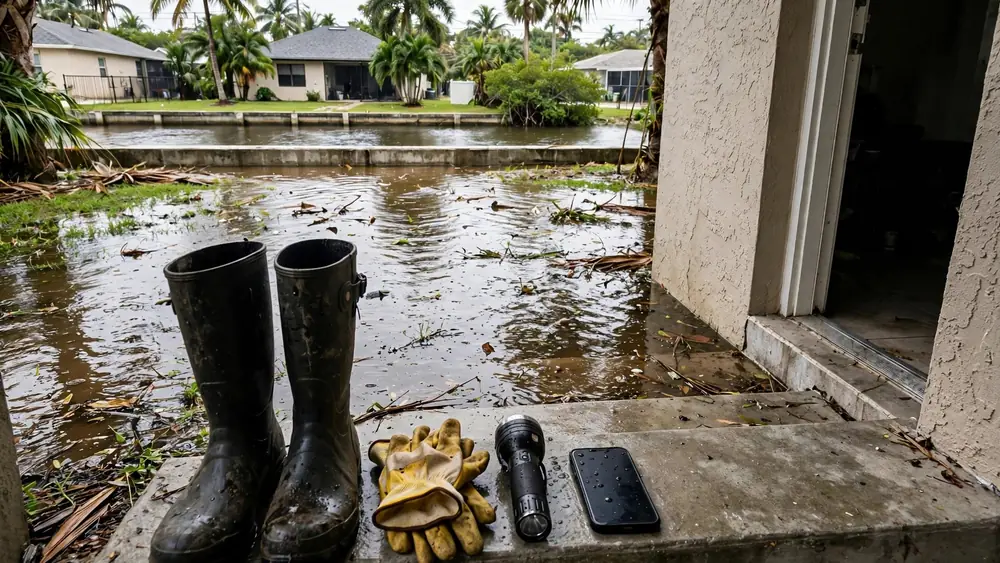
Your first visit back, step by step
- 1
Go in daylight
Bring a flashlight, boots, heavy gloves and a mask. Tell someone where you are going.
- 2
Walk around the outside first
Look for downed lines, damaged roofs, leaning walls and gas smells before going in.
- 3
Keep the power off if water reached the panel or outlets
Have an electrician clear it before turning anything on.
- 4
Take pictures before moving things
Get wide shots, waterlines with a tape measure, and close-ups of damaged items.
- 5
Report the loss to your insurer
Ask what they want you to do, and write down names and claim numbers.
- 6
Remove standing water and mud
Silt comes off more easily while still wet.
- 7
Remove soaked porous items
Carpet, pad, mattresses and upholstery that touched floodwater usually have to go. Photograph them first.
- 8
Start drying with control
Run dehumidifiers once power is safe. Fans alone are not enough, and outdoor air is usually humid.
Why it helps to know what kind of water you had
Rising water from outside, rain through a roof and a broken pipe are not handled in the same way. Outside water should be treated as contaminated, and in this part of Florida it may contain salt. Rain through a roof begins cleaner but still soaks insulation, and it may have been in the attic for a day or more. Plumbing damage may be cleaner still. If you can tell which you have, note it down for the contractor and the insurer, since wind and flood are often covered differently.
Two recent examples show why you should not assume. In Ian most sensors placed in Port Charlotte stayed dry because of offshore winds [5], leaving many homes with wind and rain damage. Helene and Milton brought estimated coastal peaks of 2 to 5 and 4 to 8 feet in Charlotte County [6] [7].
What to do about food, water and appliances
Throw out food that touched floodwater. Refrigerated food may not be safe after a long outage, and if your utility issues a boil-water notice, follow it. Appliances that were under water need a technician's opinion before being switched back on. Salt water in particular can damage controls, and problems may show up later. Photograph the model plate first, since your insurer may ask for it.
Where the 50 percent rule fits into all this
You do not need to solve the rebuild on day one, but do keep it in mind. Charlotte County requires buildings to meet current code, including elevation, when repairs or improvements exceed 50 percent of the building's value [8]. Keep your receipts and do not begin major reconstruction before talking to the permit office. Removing wet material to protect the home is usually a different question from rebuilding, but ask the county or, for city addresses, the Punta Gorda building department, if you are unsure.
What to write down each day
- Dates and timesWhen you got back, when each person came, what they did.
- People and companiesNames, phone numbers and any licence details.
- ReadingsCopies of moisture logs if a contractor provides them.
- Thrown-out itemsA running list with photos and approximate age.
- Conversations with insurersWhat was said, by whom, and the claim number.
FAQ
Questions after a hurricane flood
How soon can I go back after a hurricane?
Only when authorities say it is safe. Check county notices, watch for flooded streets and downed lines, and go during daylight. If your area is still under orders or water is still on the road, wait, even though it is frustrating.
Should I start cleaning before the adjuster comes?
Photograph everything first, then take reasonable steps to limit further damage, such as removing standing water. Ask your insurer what they want kept. Holding a small sample of carpet or drywall can help, but rotting materials should not stay in the house.
Do I need to throw away all my carpet?
Carpet and pad soaked by floodwater are usually removed, as they trap silt and contaminants. Clean-water carpet might sometimes be saved if it is dried quickly. Ask a contractor to look at it, and photograph it before removal.
Is it safe to use my tap water after a flood?
Check for notices from your utility first. If you are on a well or septic system and water reached it, get advice from the county health department or a well professional. Avoid assuming it is safe just because it runs clear.
How do I stop mold in the first few days?
Remove wet materials quickly and bring the humidity down. The EPA advises drying within 24 to 48 hours if possible. Power outages make that hard, so prioritize removal, and bring in a professional for larger areas or significant water damage.
Sources and citations
- [1]Ready.gov: Floods
- [2]U.S. EPA: Flood cleanup and indoor air quality
- [3]Florida Statutes 627.70132: Notice of property insurance claim
- [4]Charlotte County: Know your zone
- [5]National Hurricane Center: Tropical Cyclone Report, Hurricane Ian
- [6]National Weather Service Tampa Bay: Hurricane Helene impact narratives
- [7]National Weather Service Tampa Bay: Hurricane Milton impact narratives
- [8]Charlotte County: 50 percent FEMA rule