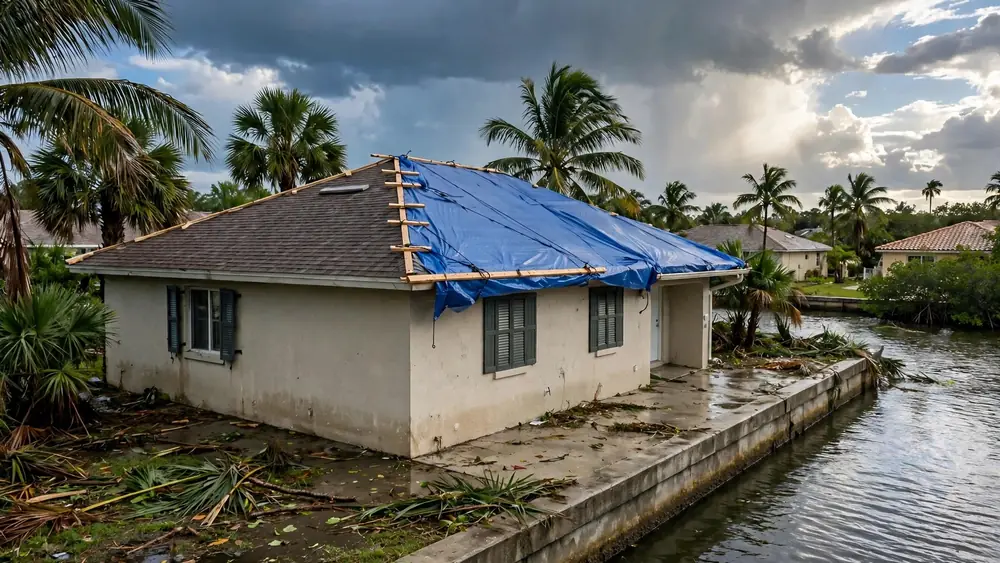
Key facts: Roof Leak Water Damage
- The National Hurricane Center says Charley's eyewall struck Punta Gorda and Port Charlotte with devastating results in 2004 [1].
- A Punta Gorda ASOS station reported sustained winds of 76 knots and a peak gust of 117 knots during Ian before it stopped reporting [2].
- Milton brought peak gusts of 70 to 80 mph across Charlotte County, with a 79 mph maximum near Punta Gorda [3].
- EPA guidance puts the drying window for water-damaged items at 24 to 48 hours [4].
How a roof leak really moves through a Florida house
Water entering at the roof rarely falls straight down. It follows the underside of the deck, runs along truss members and drips where it finds a low point or a nail. So a stain in the hallway may be caused by a damaged ridge or vent several feet away. That is why patching the ceiling, or even patching the spot directly above it, often leaves the true problem in place.
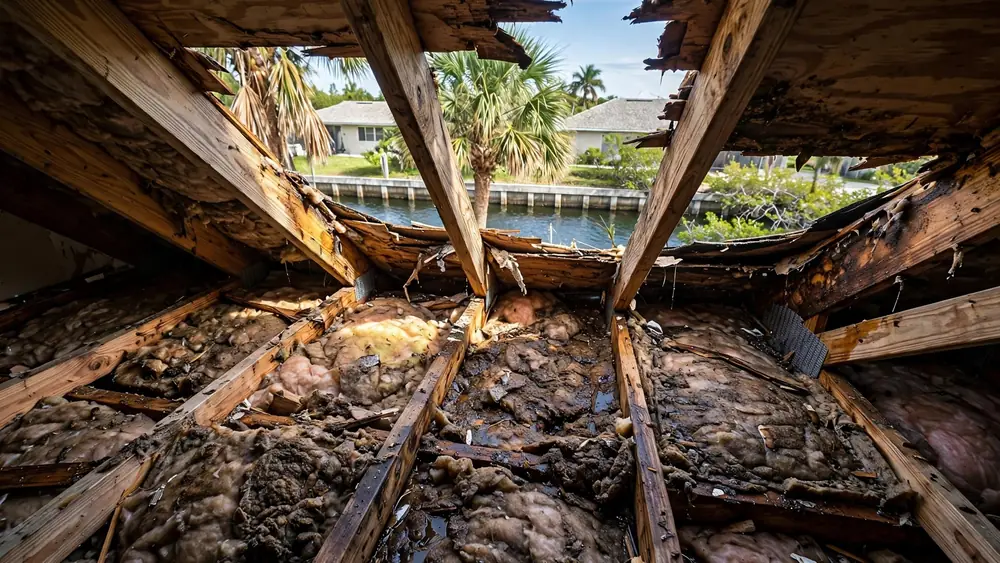
In a typical attic above a Southwest Florida home, the next thing the water meets is insulation. Blown-in insulation soaks it up and compacts into a heavy, wet mat that presses on the ceiling drywall and holds moisture against it. In a hot attic that mat can stay damp for a surprisingly long time, even after the leak has stopped, and warm dark moisture is what mold wants.
The job therefore has two halves, and they typically belong to two different trades. A licensed roofing contractor closes the opening. A restoration contractor deals with the attic, the ceiling and everything below. If the first half is not done, the second one gets repeated with the next rain.
Signs of roof water you might notice from inside
A growing brown ring
Rings mark each wetting and drying cycle, so several rings can mean it has been going on a while.
Read moreA ceiling that bulges or sags
Trapped water or wet insulation is pressing down. Stay out from under it.
Read moreDrips around light fixtures or vents
Water follows wiring and openings, so treat this as an electrical hazard.
Read moreMustiness in hot weather
A warm attic can drive the smell of damp insulation down into the house.
Read morePeeling paint high on the walls
Water may be running down inside the wall from the top plate.
Read moreShingles or tile in the yard
Debris after a storm is reason to have the roof looked at even if nothing is dripping yet.
Read more
Wind records that explain why roofs here get checked
This county's wind history is not abstract. In Charley, the eye passed over Punta Gorda and the eyewall hit Punta Gorda and Port Charlotte with what the National Hurricane Center called devastating results [1]. A report for Ian notes a Punta Gorda ASOS station with sustained winds of 76 knots and a peak gust of 117 knots before the station stopped reporting [2]. Later storms have been milder, but they still count: peak gusts in Charlotte County reached 60 to 70 mph in Helene and 70 to 80 mph in Milton [5] [3].
Winds of that size can lift shingles, break tile, peel flashing and push rain sideways under them without leaving anything obvious on the ground. So after a storm it is worth having the roof inspected even if the ceilings look fine, particularly if your roof has been through more than one recent season. Charlotte County experienced Ian, Helene and Milton in just over two years, so damage from one storm may have weakened what the next one hit.
Places roofs commonly let water in
- Flashing around vents and pipesBoots and flashings can crack or lift, especially on older roofs.
- Valleys and low slopesWater concentrates here and debris tends to collect, slowing the runoff.
- Ridge and hip capsWind often attacks these exposed lines first.
- Tile underlaymentTile sheds most water, but the layer below does much of the waterproofing. When it ages or is torn, the leak may appear with no visibly broken tile.
- Roof-to-wall jointsA lanai or addition tied into the main roof creates a joint that needs good flashing.
- Soffits and gable ventsWind-driven rain can blow in through openings that are perfectly fine on a calm day.
How the water side of a roof leak gets handled
- 1
Make it safe below
Move contents, keep people out from under any sag, and consider power to wet light fixtures. Buckets are fine for clean drips, but do not stand under a bulge.
- 2
Stop the water at the top
A roofer or a temporary tarp limits further water. Photograph the damage first, and leave roof work to people equipped for it.
- 3
Find the wet boundary
A moisture meter and thermal camera can map the wet area on the ceiling and walls. Attic inspection shows where the water really travelled.
- 4
Remove what cannot dry
Saturated insulation, sagging drywall and, sometimes, the top of wet walls come out. Removal also relieves the weight on the ceiling.
- 5
Dry the attic and framing
Air movement and dehumidification target trusses and decking. Attics are hot and may vent to the outside, which makes this harder to control than in a closed room.
- 6
Dry the rooms below
Walls and floors receive the same metered treatment as any water loss.
- 7
Check for growth
Wood and drywall paper can grow mold quickly. If it is found, the plan changes.
- 8
Rebuild and paint last
New insulation and drywall go in after materials read dry, and the ceiling is sealed and finished once the roof is confirmed sound.
Ceiling and attic materials after a roof leak
| Material | Typical outcome | What to check |
|---|---|---|
| Blown-in insulation, soaked | Removed and replaced | Mass, compaction, odor |
| Fiberglass batts, damp | Often replaced | Whether they dry fully or sag |
| Ceiling drywall, stained only | May be sealed after drying | Softness and meter readings |
| Ceiling drywall, sagging | Removed | Weight and fastener pull-through |
| Trusses and decking | Dried in place | Readings, staining, soft spots |
| Attic ducts and air handler | Inspect | Wet duct wrap, disconnected runs |
Ducts
Why a roof leak can wreck your air-conditioning ducts
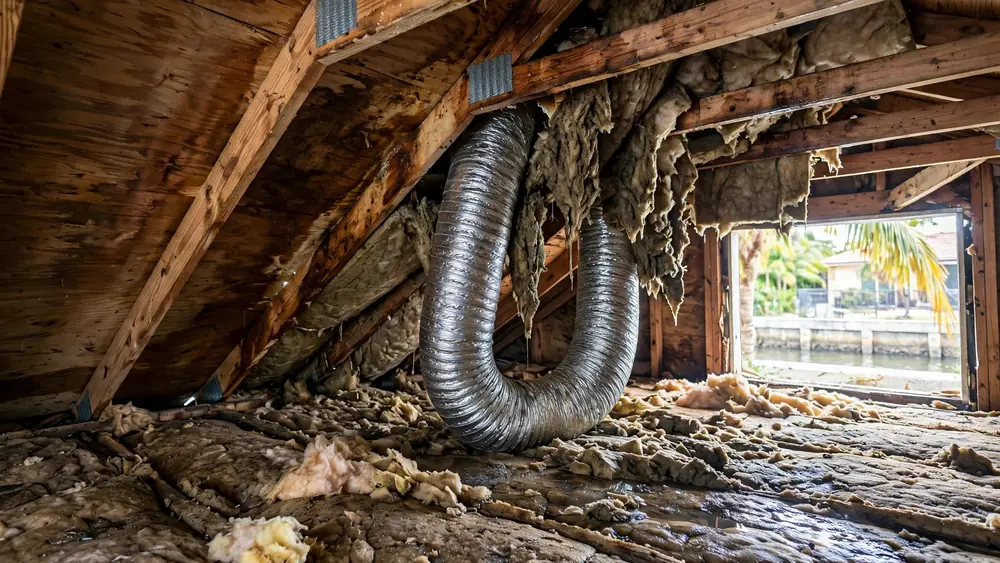
In many Florida homes, ductwork runs through the attic, sometimes with the air handler up there too. Flexible duct insulation soaks up water like any other. Wet duct wrap sags and can tear, and damp ducts can carry musty air straight into every room.
So add ducts to your checklist. If they got wet, ask an HVAC technician to inspect them, and do not assume the musty smell is just the ceiling. Running air through contaminated ducts risks spreading the problem across the home, so bring this up before any dry-out starts.
- Check duct wrap for soaked sections
- Look at the air handler if it is in the attic
- Ask before running the system again
Staining versus damage: a test you can do from the floor
Not every stain means replacing a ceiling. A dry, firm stain from one short leak may be cleaned up with a stain-blocking primer once the roof is fixed and the area reads dry. A soft, sagging or crumbling ceiling is a different matter, and so is a stain that keeps growing or a ceiling that smells musty.
To check, look at the stain over a few days and mark its outline in pencil. If it spreads after rain, the leak is still active. Press lightly on the area with a broom handle only if there is no bulge and you are not directly under it. Sponginess signals saturated gypsum. If in doubt, leave it to a contractor who can meter it.
Tile, shingle and metal roofs around Port Charlotte
Shingle, tile and metal roofs all appear in the neighbourhoods around Charlotte Harbor, and each one leaks differently. Shingles tend to fail from lifted tabs and worn flashing, and the sign is often visible. Tile may look perfect from the street while the underlayment below is failing, particularly if the roof has been through several storms. Metal roofs handle water well but rely on fasteners and seams, which can loosen or corrode in salty air.
Each of these needs a roofer's judgement rather than a restorer's, so ask both trades to talk to one another. Florida contractor licences can be checked on the state portal [7]. A roofer's scope and a restorer's scope should not leave gaps, such as who is responsible for checking the attic ducts or replacing insulation.
Tarps and temporary protection
After a storm a tarp may be the only thing keeping water out for a while. Temporary covering is commonly seen as a reasonable step to limit damage, and most policies expect you to take reasonable steps. Check your own policy. Keep receipts for anything you buy, and photograph the roof before and after the tarp goes on.
Tarps don't last forever, particularly in strong sun and repeated wind. Check them after each storm, and do not treat a tarp as a repair. If rebuilding takes months because roofers are busy after a regional storm, keep drying and re-inspecting the rooms beneath, as a slow leak under a loose tarp can quietly undo the work.
Finding a leak that only shows up in certain storms
Some leaks appear only in strong wind-driven rain from one direction. These are hard to trace, because they may be dry on the day someone comes to look. Keep a simple diary: the date, the wind direction if you know it, how heavy the rain was, and where the water appeared. Take photos of the stain each time.
A roofer may use water testing on suspect areas, working from the bottom of the roof upward so that any leak can be identified. Thermal imaging can also help find damp insulation after a rain. A good diary gives them somewhere to begin, and it also becomes useful evidence for your insurer.
Slow leaks and mold in the attic
Roof leaks that have been going on quietly often mean mold on the deck or truss members. Do not assume that black marks are mold, or that they are not; some are old stains. The EPA recommends fixing the moisture first, cleaning hard surfaces and discarding porous materials that cannot be cleaned, and it advises considering professional help above about 10 square feet or after significant water damage [4].
Sampling is not always needed when mold is visible, but if you want an assessment, Florida's rules keep the two roles apart in most cases: an assessor generally cannot remediate a structure they assessed within the previous twelve months, nor the other way around [8]. Ask each company to say which role they are playing.
Reporting roof damage to your insurer
Wind claims and flood claims usually sit under different coverage. Rain that came through a wind-damaged roof is often treated differently from water that rose from outside, so keep evidence that shows how each entered your home. Read your policy and talk to your agent, because wind deductibles and exclusions vary considerably.
Florida law generally bars a new or reopened claim unless notice reaches the insurer within a year after the date of loss, and a supplemental claim within eighteen months [9]. If you see signs months after a storm, do not assume it is too late, but also do not put it off. Photos from before and after the storm can help show when the damage happened.
Telling roof water from other ceiling water
| Clue | Points toward | Next check |
|---|---|---|
| Appears only during rain | Roof or flashing | Attic after the next rain |
| Appears on dry days | Plumbing or AC | Lines above that ceiling |
| Near the air handler or duct | Condensate or duct sweat | Drain pan and duct wrap |
| Under a bathroom | Supply or drain line | Run the fixtures and watch |
| Worse in the humid season | Condensation | Attic ventilation, duct leakage |
Permit questions for roof and ceiling repairs
Roofing work in Florida generally goes through a permit and inspection process. For most of Port Charlotte, that means Charlotte County Community Development, and in Punta Gorda it means the city's own building department.
A contractor who works here regularly should be able to explain the process and whether they will obtain the permit. If someone suggests skipping it, ask why, and check with the permit office yourself.
Keeping the attic out of trouble
- Inspect after every named stormCheck the attic with a flashlight if it is safe to do so, as well as the yard for debris.
- Clear gutters and valleysBlocked valleys and gutters hold water against roof edges.
- Photograph the roof each yearA dated set helps when you need to show what changed.
- Trim back branchesLimbs that rub or fall are a common way to open a roof.
- Check attic ductsAsk your HVAC technician to look at wrap and connections during servicing.
What to tell the contractor on the phone
Mention when the water appeared and whether it coincided with rain. Tell them which room, whether the ceiling sags and whether any light fixtures are affected. Say if the roof has already been tarped or repaired, and by whom. If you can get into the attic safely, or if a roofer has been there, describe what was found.
This helps the contractor decide what to bring and whether to coordinate with a roofer first. If they are not able to help with a specific part, they can tell you that on the call.
Skylights, solar mounts and other roof penetrations
Every hole cut through a roof is a place that relies on sealant and flashing. Skylights, solar panel mounts, satellite brackets, plumbing vents and bath fans all count. Older sealant shrinks and cracks in strong sun, and a bracket added years after the roof went on may not have been flashed the way the roofer would have wanted.
If your stain sits near one of these, mention it. Ask who installed the item and whether any roof warranty is affected by the penetration. With solar panels in particular, the roofer may need the array's installer involved before anyone lifts a panel, so bring both companies into the conversation early rather than leaving the attic wet while they sort it out.
Soffits and fascia
Rotted fascia and loose soffit panels let wind-driven rain into the attic edge, where it soaks the insulation first. Look along the eaves from the ground after each storm.
FAQ
Roof leak water damage questions in Port Charlotte
Should I poke a hole in a bulging ceiling to let the water out?
It is risky. A bulge can drop suddenly, and wet drywall is heavy. If water is clearly pooling and you decide to act, stand well clear and protect the floor, but it is safer to keep everyone out of the room and call for help.
Can a stained ceiling just be painted?
Only after the roof is fixed and the drywall reads dry, and only if it is still firm. A stain-blocking primer goes on before paint. Painting over a live leak or over wet board hides the problem for a short while and traps moisture.
Do I call a roofer or a restoration contractor first?
Stopping the water usually comes first, so a roofer or tarp is often the first move when the roof is open. If water is already through the ceiling, restoration should follow quickly. The two should share what they find.
How long can wet attic insulation stay in place?
Not long. Wet insulation adds weight and keeps framing damp, and the EPA's 24 to 48 hour drying advice applies here. Blown-in material often can't dry where it sits, so removal is commonly recommended when it has been soaked.
Will my homeowners insurance pay for a roof leak?
That depends on your policy, the cause and how long the leak was going on. Insurers treat sudden storm damage and slow wear differently. Report it promptly, document the damage and read your wind deductible, or ask your agent to explain it.
Why does my ceiling only leak in some storms?
Wind direction often decides. Rain blown sideways can get under flashing or into vents that stay dry in ordinary rain. Keep notes of dates, wind direction and where water appeared, so a roofer has something to test against.
Are the attic ducts part of a water damage job?
They should at least be checked. Wet duct wrap can sag and tear, and damp ducts may spread musty air. Ask whether an HVAC technician should inspect them, and do not assume the air conditioner is unaffected just because it still runs.
Is a roof inspection worth it if nothing is dripping?
After a named storm it usually is, especially on a roof that has been through several recent seasons. Damage to flashing or underlayment may not leak until the next heavy rain, and earlier photos help if you later need to report it.
Sources and citations
- [1]National Hurricane Center: Tropical Cyclone Report, Hurricane Charley
- [2]National Hurricane Center: Tropical Cyclone Report, Hurricane Ian
- [3]National Weather Service Tampa Bay: Hurricane Milton impact narratives
- [4]U.S. EPA: A brief guide to mold, moisture and your home
- [5]National Weather Service Tampa Bay: Hurricane Helene impact narratives
- [6]Ready.gov: Floods
- [7]Florida DBPR: Licensing portal
- [8]Florida Statutes 468.8419: Mold assessor and remediator prohibitions
- [9]Florida Statutes 627.70132: Notice of property insurance claim