Key facts: AC and Plumbing Leak Damage
- The EPA recommends keeping indoor relative humidity under 60 percent and says quick drying usually stops mold from taking hold [1].
- Port Charlotte's median age was 53.8 at the 2020 census, and 31 percent of residents were 65 or older [2].
- The IICRC S500 is the widely used trade reference for water damage procedures, covering drying, equipment, safety and documentation [3].
- Florida law generally bars a new or reopened property insurance claim unless notice is given within 1 year of the loss [4].
Why leaks from inside are a Florida problem all year
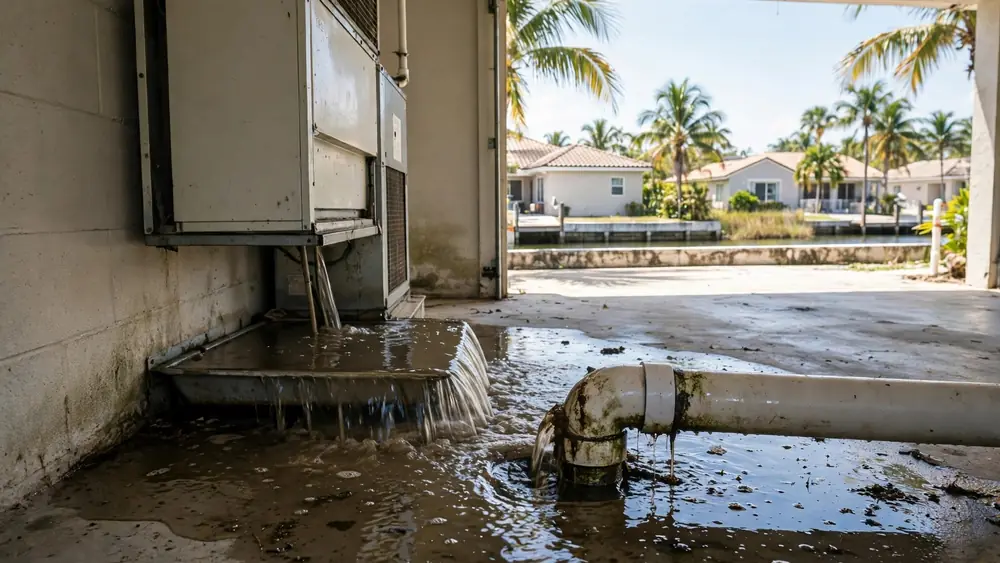
An air conditioner works by pulling water out of the air, and that water has to go somewhere. It collects in a pan under the indoor coil and leaves via a drain line, commonly a small PVC pipe that exits outside or into another drain. In a warm wet climate that line grows slime and algae. When it clogs, water can fill the pan and spill over, quietly, for days. The closet, the hallway and the wall behind it become soaked before anybody notices.
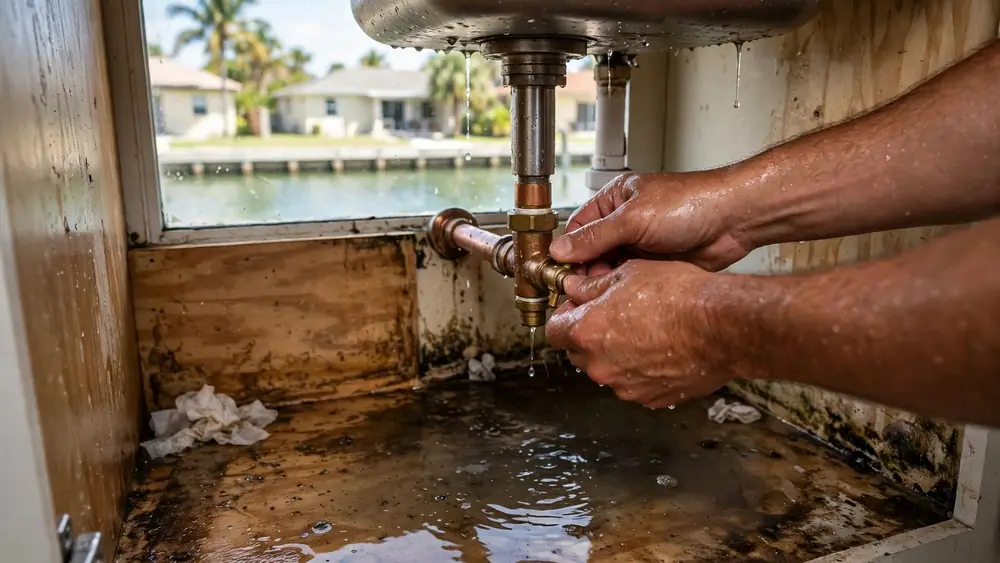
Plumbing failures are the other half of this page. A burst braided supply line under a sink can release a lot of water in very little time. Water heaters leak from tanks, relief valves and fittings. Drains back up. Pipes can leak inside a wall or under a slab. These events usually begin with clean water, which gives you a better starting position than a flood, but only if it is found early.
Clues pointing to an inside leak
Wet floor beside the air handler
The drain pan may be overflowing, or a line has come apart.
Read moreCeiling stain under an attic unit
An attic air handler can leak through the ceiling on a dry day.
Read moreA water bill that jumps
A hidden leak may show up on your bill before it shows up on a wall.
Read moreWarm spots on a tile floor
Hot-water line leaks under a slab can warm the floor above.
Read moreSwollen cabinet toe-kicks
Sink and dishwasher leaks hit the base of the cabinet first.
Read moreMusty smell on returning home
A closed house with a small leak can grow mold over the weeks you were away.
Read more
Common inside leaks and how they behave
| Source | How it usually shows | What to do first |
|---|---|---|
| AC condensate overflow | Slow water at the closet or under an attic unit | Switch the system off, call an HVAC tech |
| Sink or toilet supply line | Sudden, large volume | Shut off the valve or the main |
| Water heater | Pool at the base, sometimes rust | Shut off water and heater power or gas |
| Washing machine hose | Sudden water near the laundry | Turn off valves, unplug only if dry |
| Dishwasher or fridge line | Cabinet swelling, flooring lift | Shut off the local valve |
| Drain backup | Dirty water at low fixtures | Stop using fixtures; treat it as contaminated |
| Slab leak | Warm floor, damp spots, high bill | Shut the main, call a plumber |
Clean water does not stay clean for long
The trade describes water by how contaminated it is, and the IICRC S500 standard is a main reference for restoration procedures [3]. Our water source table gives you a plain summary. Supply-line water usually begins clean. Air conditioning condensate is fairly clean but may carry slime from the pan. Toilet overflows and drain backups are a different matter and need protective handling. Sewage, or anything that has mixed with it, calls for professional help.
Water that sits changes. In a warm house it picks up what it runs across, and it feeds bacteria and mold. That is why a clean leak found on Monday can be treated very differently from the same leak found three weeks later, and why it matters to tell the contractor honestly how long the water may have been there.
How an inside leak is usually handled
- 1
Stop the water
Shut the local valve or the main. For an AC overflow, switch the system off at the thermostat, then have the drain cleared.
- 2
Bring in the right trade
A licensed plumber or HVAC technician repairs the source. Restoration work cannot finish until this is done.
- 3
Map the wet area
Moisture meters find how far water travelled, especially under flooring and along the base of walls.
- 4
Remove what is trapping water
Toe-kicks, baseboards, sections of drywall or floating floors may need to come off.
- 5
Dry with control
Air movers and dehumidifiers bring materials down to dry-standard readings.
- 6
Check for mold
Slow leaks especially need a look behind the wall.
- 7
Replace and retest
Rebuild only after readings confirm dryness, then watch the repaired source for leaks.
Condensate
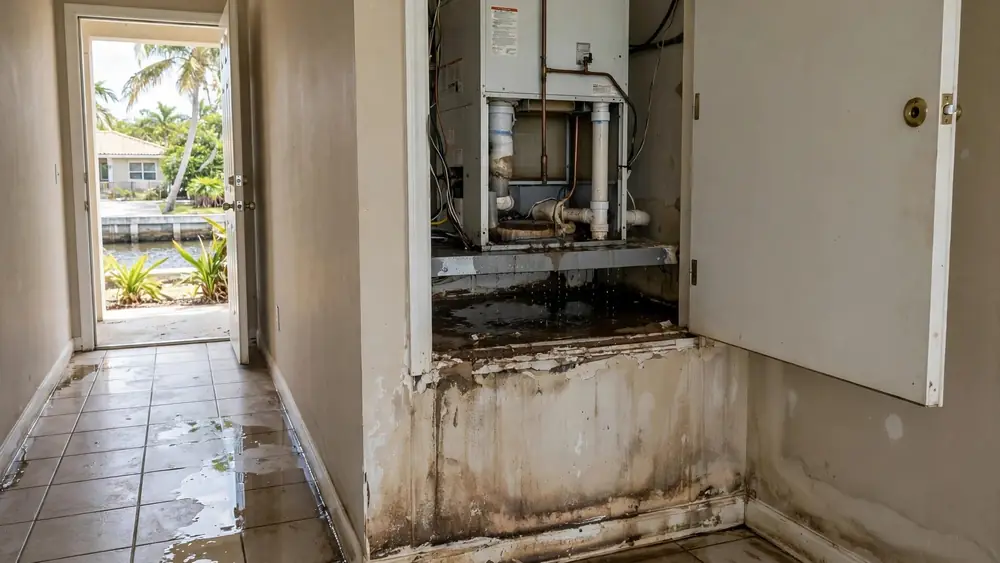
The air handler closet, up close
Many homes keep the air handler in a small closet off a hallway, often on a platform or a short stand. A clogged drain line lets the pan overflow, and water runs down to the slab, then along under the closest wall. It does not take much water to wet the bottom of two or three walls.
Newer units may have float switches, which shut the system off when the pan fills. If your system stops cooling and you find water, that switch may have done its job. Ask your HVAC technician to clear and test the drain as part of regular servicing, and ask whether a secondary pan or switch makes sense for your system.
- Check the pan during routine filter changes
- Keep the closet free of stored boxes
- Have the float switch tested
Long absences and seasonal homes
A lot of Port Charlotte owners spend part of the year away. With a median age of 53.8 and nearly a third of residents over 65 at the last census [2], this is a community where a house may sit shut for months. A small leak with nobody home has time to reach several rooms, and the air conditioning, often left at a higher setting to limit humidity, may not keep up.
Practical protections include having someone check the house on a schedule, turning off the main water when you leave, and using leak sensors that alert you by phone. Talk to your plumber about whether shutting off the main affects anything, such as an ice maker, an irrigation system or a fire sprinkler. Also check your insurance policy: some policies have conditions for vacant or unoccupied homes, so read those parts or ask your agent.
Slab leaks and water under the floor
Many homes here run water lines through or under the concrete slab. When a line fails beneath the slab, water can rise through cracks and joints or travel along the pipe and appear somewhere surprising. Warm spots on a floor, the sound of running water with everything off, and a meter that keeps turning are all classic clues.
Finding one calls for a plumber, usually with listening or pressure-test equipment. Sometimes they will reroute the line rather than cut through the floor. Restoration comes after that repair, and may involve lifting floor coverings so the slab has a chance to dry. Drying a slab from the top can be slow, which is why replacing flooring before testing moisture is a frequent mistake.
Water heaters: garages, closets and attics
Water heaters are frequently placed in a garage or utility closet, and sometimes in the attic. A failed tank can empty itself and then keep filling for as long as the water is on, so shut off the cold-water supply first. For electric units, the breaker should be turned off only if you can reach a dry panel. For gas units, follow the manufacturer's instructions or ask your gas supplier.
If the tank is in a garage on a raised stand, the leak may run out the door without touching the house. In an interior closet it hits walls right away. Rust at the base, a leaking relief valve and damp fittings are early warning signs worth paying attention to, and they are easy to spot during a regular look around.
Cabinets, vanities and the pocket under the sink
Kitchen and vanity leaks have a way of hiding. Water pools on the cabinet floor and runs down behind it onto the slab, while the front of the cabinet looks fine. By the time the toe-kick swells, it may have been happening for a while. Empty the cabinet, shine a flashlight along the back corner and press the panel. A soft or delaminating base is a strong clue.
Restoration may involve removing the toe-kick or drilling discreet holes so air reaches the void. A countertop and cabinet can sometimes be saved in place, but particleboard that has swollen rarely returns to its original shape. Ask for a straightforward view of what can dry and what cannot, along with readings to support it.
Laundry rooms, refrigerator lines and small plastic parts
Plastic icemaker tubing, washing machine hoses and dishwasher connections fail more often than you would think, since they sit out of sight for years. Braided stainless lines are a common upgrade, though they too have a service life. Replacing hoses on a schedule is one of the simplest forms of protection.
Installing automatic shutoff valves, either at the washing machine or for the whole house, is something to ask a plumber about. Sensors on the floor near the water heater, under sinks and in the air handler closet can be useful in a house that is sometimes empty. None of these guarantee anything, but they tend to shorten the time water runs.
Drains and toilets: when the water is not clean
A backup from a toilet or floor drain is treated as contaminated. Stop using sinks, showers and toilets until a plumber clears the line, because anything you put down the drain may come back up. Keep children and pets out. The cleanup usually involves removing porous materials touched by the water and disinfecting the hard surfaces.
Depending on where you live around Port Charlotte, your home could be on a public sewer or a septic system, and the cause may be very different. Ask your utility or a plumber. After major storms and flooding, sewer and septic systems can be overloaded, so heed notices from your utility or the county.
Who pays attention to what: splitting the trades
Inside leaks often involve more than one trade. A plumber fixes pipes. An HVAC technician clears drains and looks at coils, pans and ducts. A restoration contractor removes water and dries the structure. A general contractor or specialist rebuilds. Mold assessment or remediation may be separate again, and Florida's rules generally stop one company from doing both assessment and remediation on the same structure within twelve months [5].
Ask each of them to tell you clearly what their part is and what they are not doing. Check licence details through the state portal [6]. Keeping notes of who said what and when helps a lot, especially if an insurer asks later.
Insurance and the question of how long
Insurers often distinguish between sudden water damage and damage from a long-term, repeated leak. Read your policy for wording about seepage or leaks over time, and report promptly once you know of a loss. Florida's statute sets outer limits on notice, generally one year for new or reopened claims and eighteen months for supplemental ones [4], but your policy may also require prompt notice.
Take pictures of the failed part and keep it if you can, because a burst fitting or hose may be useful evidence. The insurance deadlines guide goes through this in more depth, and the Florida Office of Insurance Regulation publishes consumer resources [7].
Habits that catch leaks early
- Look at the drain pan monthlyDo it when you change the filter, and have the line cleared if water sits there.
- Read your water meterWith nothing running, the meter should stand still.
- Open the cabinetsA quick look under sinks with a flashlight goes a long way.
- Replace old hosesFollow the maker's recommended life and replace bulging lines right away.
- Hold indoor humidity under 60 percentA hygrometer can spot trouble in a closed-up house [1].
- Set up absence routinesShut the main, schedule house checks and add a sensor near the air handler.
After the repair: watching for a return
Once the leak is fixed and everything reads dry, keep watching for a few weeks. Mark the edges of any stain, put a dry paper towel under a repaired joint, and check the moisture level with a hygrometer on muggy days. Run the air conditioner normally and look at the pan again. If the smell comes back, or a wall becomes soft, call back and ask for another reading.
Take dated photos of the finished state as well. Should another leak happen, they will show what was resolved earlier and what is new.
Telling condensation from a real leak
Not all moisture around an air conditioner is a failure. Cold ducts and refrigerant lines can sweat in humid air, especially where insulation has slipped or the closet door is left open to warm attic or garage air. Sweating usually leaves damp patches right on or beneath the cold surface and comes and goes with the weather. A leak tends to spread, and it keeps going whether the day is muggy or not.
Dry the area, watch it for a day or two, and take a photo each morning. If water returns in the same place with the system off, look to the plumbing. If it only returns with the system running, the air conditioning is the likely culprit, and an HVAC technician can tell you whether it needs a drain cleared, an insulation repair or something more. This small test can direct your first call to the right trade.
Toilets and the wax seal
A failing wax ring can leak at the base each time the toilet flushes, staining the floor around it.
FAQ
Port Charlotte AC and plumbing leak questions
Should I keep running the AC if the drain pan overflowed?
Turn it off until the drain is cleared. Running it keeps making water. If you need cooling during summer heat, ask an HVAC technician how soon it can be cleared, and do not bypass any float switch that has shut the system down.
How do I know if a leak is under the slab?
Warm floors, running-water sounds with all fixtures off, damp patches and a meter that keeps moving are the usual clues. A plumber can confirm it with pressure testing or listening gear. Shut the main valve if water is reaching your floors.
Can a slow AC leak cause mold in the wall?
Yes. Slow leaks keep the base of the drywall damp, and that can feed mold within days. Follow the EPA's advice to dry promptly, and ask for the lower wall to be metered or opened if there is a smell or staining.
What should I do when I come home to a flooded house?
Do not rush in. Check for electrical hazards, turn off the main if safe, and take pictures before moving anything. Mold may already be present after weeks in a warm house, so be careful with fans and call for an assessment.
Is a water heater leak an insurance matter?
It might be, depending on your policy and the damage done to the home. Policies often treat the failed heater differently from the water damage it causes. Report the loss promptly, keep the old part if possible, and ask your insurer.
Do I need a plumber before I call a restoration contractor?
Stop the water first, and call whichever gets things moving soonest. A plumber repairs the source, while restoration deals with the wet structure. Many homeowners end up calling both on the same day, so do not hold off on either.
Are sensors and auto shutoff valves worth considering?
They may be, particularly for homes that sit empty for months. They shorten the time water runs but they are not a guarantee. Ask a plumber about options, and ask your insurer whether the policy treats these devices in any particular way.
Why does the wall behind my closet stay wet after the leak was fixed?
A shallow wall cavity on a slab has little airflow, and drywall holds water for a long time. Baseboards may need to come off or holes may need to be drilled for air. Ask for readings to see whether things are improving.
Sources and citations
- [1]U.S. EPA: A brief guide to mold, moisture and your home
- [2]Wikipedia: Port Charlotte, Florida
- [3]IICRC: ANSI/IICRC S500 water damage restoration standard
- [4]Florida Statutes 627.70132: Notice of property insurance claim
- [5]Florida Statutes 468.8419: Mold assessor and remediator prohibitions
- [6]Florida DBPR: Licensing portal
- [7]Florida Office of Insurance Regulation