
Key facts: AC and Plumbing Leaks in Deep Creek
The leak you are most likely to get here
On a typical slab-and-block house here, three causes come up again and again: an air handler pan overflowing because the drain has clogged, a sink or toilet supply line failing, and a water heater giving out. Each releases water at floor level, and it travels under the nearest wall. Air conditioning runs for much of the year in this climate [4], so the drain line works hard and it needs regular attention.
Slab leaks are less common but more confusing. A line under the floor can show up as a warm spot, a damp patch or a meter that never stops moving. A plumber can confirm it, then you can decide what to do about the floor.
Deep Creek leak sources and first moves
| Source | Clue | First move |
|---|---|---|
| AC drain line | Water at the closet, system shuts down | Turn system off, call HVAC |
| Supply line | Sudden water under sink or toilet | Close valve or main |
| Water heater | Pool at the base | Shut the cold-water valve |
| Slab line | Warm or damp floor, meter moving | Shut the main, call a plumber |
| Irrigation near wall | Damp baseboard on one side | Turn off the system and inspect |
What to do in the first hour
- 1
Stop the water
Close the local valve or main.
- 2
Turn off the AC if the pan overflowed
Do not bypass the float switch.
- 3
Stay away from wet electrics
Only use the panel if it is dry.
- 4
Photograph
Include the failed part and affected walls.
- 5
Call the right trade
Plumber or HVAC for the source.
- 6
Call about drying
Water under flooring needs measuring, not guessing.
Utilities
Who supplies your water
Local references say Deep Creek gets utilities from both Punta Gorda and Port Charlotte [1], so check your bill to find out who supplies yours. This matters if you suspect a leak before the meter, a street-side problem or a sewer backup. Keep that number handy, along with any boil-water notices after storms.
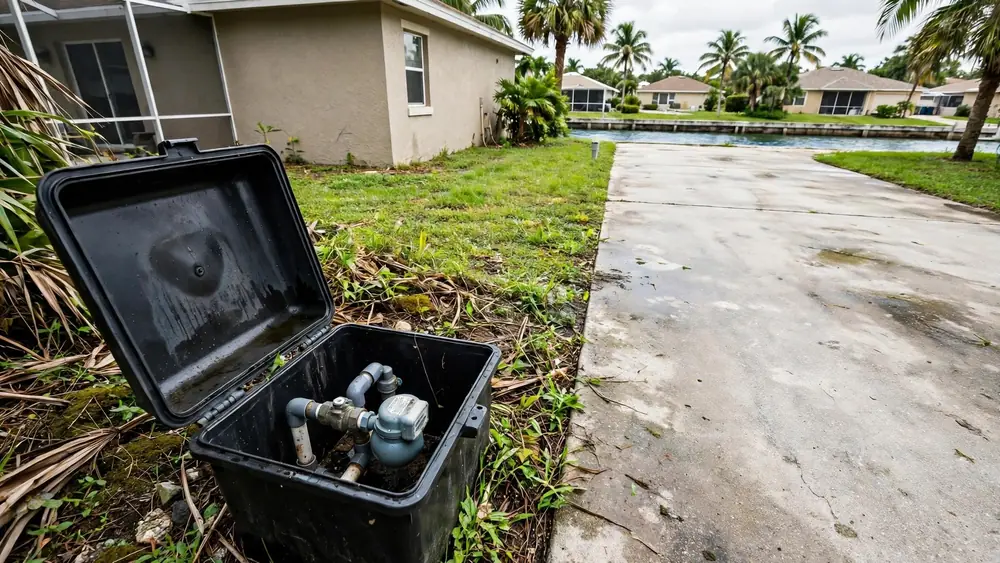
Learn how to read your meter. If everything is off and the meter still moves, there is a leak somewhere between it and the fixtures. It is a simple test that can save you days of uncertainty.
- Find your supplier on the bill
- Check the meter with everything off
- Save the utility's phone number
Irrigation and outside lines
Many inland lawns are irrigated, and a broken line near the house can keep the base of a block wall wet. It may look like an inside leak, with bubbling paint and swollen baseboards. Walk the outside during a watering cycle, and look for heads that hit the wall. Turning the system off for a day or two and watching readings can help separate outside sources from inside ones.
Closed-up homes and long absences
If you leave for the summer, a clogged drain line has months to soak the floor while the house stays warm and humid. Clear it before you go, consider shutting off the main with your plumber's advice, and ask someone to check on things. A small sensor near the air handler can be useful. Check your policy's wording on vacant or unoccupied homes.
When you return and find musty air, look before you move air. Mold may be present. The EPA advises professional help above about 10 square feet or after significant water damage [2].
Sewer, septic and the dirty side of plumbing
A backup is contaminated water. Stop using fixtures, and call a plumber. Depending on the street, you may be on public sewer or septic, and the fix differs. Heavy rain can strain both. If there are signs of sewage on your floors, keep children and pets out, and let properly equipped people handle the cleanup.
Getting the paperwork right
Report leaks to your insurer early if you plan to claim. Insurers often distinguish sudden damage from long-term seepage, so keep the failed part and record when you found the problem. Florida's general limits are one year for new or reopened claims, and 18 months for supplemental claims [3]. Keep moisture logs and invoices together, and verify licences at the state's portal [5].
For the full process, see the AC and plumbing leak page, and for the community, the Deep Creek page. Drying steps are on the extraction and drying page.
Rebuilding after an inside leak
Inside leaks usually require less demolition than floods, but anything closed up too soon can bring the problem back. Wait for dry readings. If you are replacing floors over a slab, ask for a moisture test against the flooring maker's limits. Permits for plumbing or electrical work in this unincorporated area generally go through the county, and deed restrictions rarely apply to interior work, though you should check any that do.
Small habits that catch leaks
- Check the panLook when you change the AC filter.
- Read the meterDo a monthly test with everything off.
- Look under sinksUse a flashlight and feel the base.
- Replace old hosesFollow the maker's recommended life.
- Set a sensorPut one near the air handler and water heater.
FAQ
Deep Creek AC and plumbing questions
Why did my AC shut itself off and leave water on the floor?
A float switch may have detected a full pan and stopped the system. That usually means the drain line is clogged. Clear the water, and call an HVAC technician to clear the drain. Do not bypass the switch to keep cooling.
How do I test for a hidden leak?
Turn off all fixtures and look at the water meter. If it keeps moving, you probably have a leak. A plumber can then locate it. Warm spots on tile, damp patches and rising water bills are other clues worth mentioning on the call.
Who do I call if the leak is on the street side?
Your water supplier, which you can identify from your bill. Local references mention both Punta Gorda and Port Charlotte utilities in this area. If the meter box is flooded or a line is broken in the yard, they can tell you whose responsibility it is.
Can irrigation damage my walls?
It can. A head hitting the wall or a broken line nearby may keep block and baseboards damp. Inspect during a watering cycle, and turn the system off for a while to see whether moisture readings improve.
Should I shut off water while I am away?
Often yes, but ask your plumber first, because some equipment depends on it. Shutting the main limits how much water can leak in your absence. Pair this with a clean AC drain and someone who checks in on the house.